

Bearing seat settlement deformation monitoring system
I. Requirement Overview Bearing seat position monitoring system: The actual ship shaft is approximately 100m long. The position of each bearing section in the cabin is measured to monitor the deformation of the bearing seat. A hydrostatic leveling system is considered for monitoring, providing deformation reference data for the bearing seat deformation.
I. Requirements Overview
Bearing seat position monitoring system: The actual ship shafting length is approximately 100m. The position of each bearing section in the compartment is measured separately to monitor the deformation of the bearing seat. A hydrostatic leveling system is considered for monitoring to provide deformation reference data for the bearing seat deformation.
II. Technical Route and Implementation Process
Deformation monitoring is divided into in-dock construction and post-launch bearing seat deformation monitoring.
The technical route uses hydrostatic leveling instruments for automated monitoring under different operating conditions, verifying hull attitude and deformation, and cooperating with automated deformation monitoring analysis software to monitor the hull bearing seat deformation in real time.
Hydrostatic Leveling Instrument Selection Statement:
Because crystalline silicon hydrostatic leveling instruments have the characteristic of instantaneous response, under good measurement conditions (vibration, environment, temperature), they can meet both in-dock (static) and underwater (relatively static) conditions, so they are temporarily considered as the first choice. Because canned hydrostatic leveling instruments do not have the characteristic of instantaneous response, they may not be usable in the underwater (relatively static) state; however, their measurement data is stable, and their low environmental requirements make them the preferred choice for in-dock measurements.
2.1 System Composition
This monitoring system mainly includes: crystalline silicon hydrostatic leveling instrument, basic data acquisition system, and data analysis and statistics system.

2.2 Monitoring Data Synchronization
Using crystalline silicon hydrostatic leveling instruments instead of traditional canned hydrostatic leveling instruments to obtain monitoring data in real time, ensuring that the hull attitude does not change during data transmission of each monitoring position of the hull bearing seat.
2.3 Technical Route

III. Crystalline Silicon Hydrostatic Leveling Instrument
3.1 Principle of Crystalline Silicon Hydrostatic Leveling Instrument
A crystalline silicon hydrostatic leveling instrument is a differential pressure sensor that uses the change in pressure value between various monitoring points to calculate the settlement. The sensor has a small volume and a large range. Within its range, it can be installed according to the ground trend without leveling.
3.2 Working Principle of Crystalline Silicon Hydrostatic Leveling Instrument System
The entire hydrostatic leveling instrument monitoring system uses a wired (fiber optic) communication method, consisting of a receiver, transmitter, hydrostatic leveling instrument, 485 bus, connecting water pipe, and automated monitoring software.
After the hydrostatic leveling instrument is installed, set the parameters in the automated monitoring software. After running the software, the transmitter collects data from the hydrostatic leveling instrument according to the collection time set by the software and then sends it to the PC's acquisition software.

IV. Data Processing Platform
4.1 Introduction to the Cloud Platform
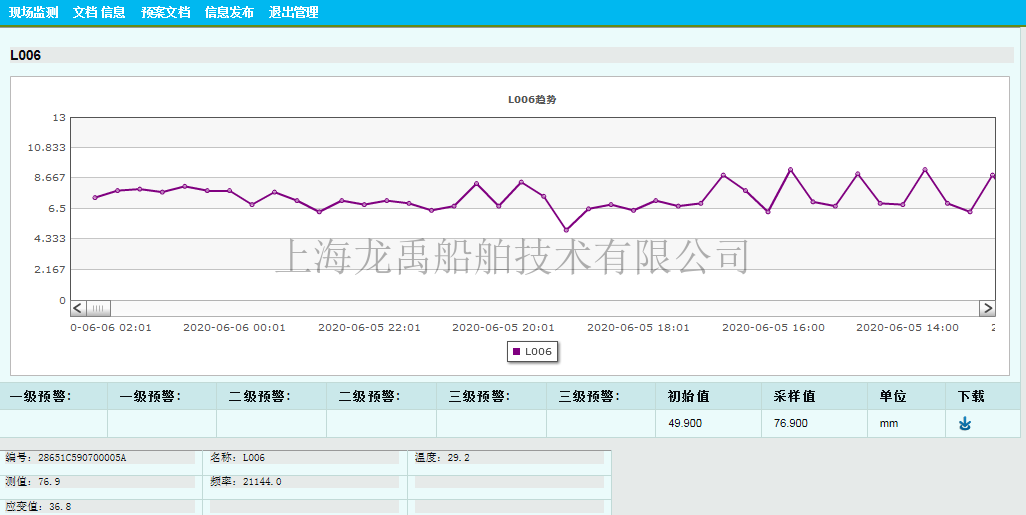
The software analysis system mainly includes two parts: ① Basic data acquisition system ② Data analysis and statistics system.
A server is built in the factory. The system mainly consists of a hydrostatic leveling instrument monitoring system, a data transmission system, and a cloud platform for monitoring data processing. The system mainly monitors displacement and settlement factors in real time. Monitoring data is sent to the monitoring and early warning cloud platform for processing, analysis, storage, display, and release via a wired method. The system also provides early warnings for dangerous areas and allows for diversified early warning reminders through the system homepage, achieving system interconnection and interaction.
4.2 Basic Data Acquisition System
Main modules include:
(1) Customizable monitoring sampling interval;
(2) Automatic acquisition of basic data;
(3) Data viewing, data download;
(4) Predictive analysis;
(5) Trend analysis;
(6) Out-of-limit alarm.
4.3 Data Analysis and Statistics System
Main functions:
(1) Obtain monitoring location data results with a custom monitoring cycle;
(2) Deformation report for the same location under different operating conditions;
(3) Quickly obtain relative monitoring settlement results by specifying the analysis baseline;
(4) Long-cycle data accumulation analysis report;
(5) Data presentation: Single-point and multi-point settlement data changes.

Deformation presented by multi-point settlement data under different operating conditions
4.4 Data Analysis
(1) After the hydrostatic leveling instrument is installed, obtain the initial 0-position information. Under different operating conditions, obtain deformation monitoring data. It is proposed to use the bow and stern ends as the analysis baseline to analyze their relative displacement deformation;
(2) Select monitoring data under different operating conditions for comparative analysis to check the displacement deformation.
V. Theoretical Accuracy Assessment
5.1 Accuracy Assessment of Hydrostatic Leveling Instrument Monitoring System
Measurement accuracy of hydrostatic leveling instrument monitoring: 0.1mm.
VI. Test Installation Experiment
6.1 Test Installation Experiment Operating Conditions
According to the actual situation of the experimental site, simulate the deployment of a certain number of hydrostatic leveling instruments, mainly divided into the following steps:
(1) Scheme discussion, installation confirmation;
(2) On-site exploration, installation location and quantity confirmation, wiring layout and installation confirmation;
(3) Factory support base production, installation, and calibration, hole opening, etc.;
(4) On-site installation of hydrostatic leveling, debugging, and communication;
(5) Simulated operation, data settlement monitoring.
6.2 Data Accuracy Verification
(1) Standard height blocks can be manually added on-site to measure and verify manually corrected height;
(2) Alternatively, consider installing both canister-type and crystalline silicon-type static water level meters simultaneously to cross-verify the accuracy and stability of their data.
Company Address: Room 201, Building 11, No. 299, Bisheng Road, Pudong New District, Shanghai
Company Telephone:021-33830252
Company Fax: 021-33830253
Company Postcode: 201204
Company Email:service@shipac.com.cn