

On-site pipe measurement and pipe fabrication system
This system uses a dedicated camera and independently developed measuring tools to take close-range photographs and collect the 3D coordinates of the prefabricated pipes; it uses independently developed software and databases for 3D modeling; it outputs ticket diagrams through automatic or manual adjustments; and it uses independently developed four-axis linkage tooling workstations to produce finished pipe sections.
I. System Overview
The pre-fabricated pipe system is a solution product that integrates pre-fabricated pipe measurement, modeling, drawing, and production.
This system uses a special camera and independently developed measuring tools to take close-range photographs, collecting the three-dimensional coordinates of the pre-fabricated pipes; it uses independently developed software and databases for three-dimensional modeling; through automatic or manual adjustment, it outputs tickets; and it uses independently developed four-axis linkage tooling workstations to produce finished pipe segments.
Through the application of this system, the traditional on-site sampling of semi-finished products or model sampling methods of pre-fabricated pipes are changed, eliminating the 'two-on-one-off' production model of pre-fabricated pipes, effectively improving the quality and precision of pre-fabricated pipes, and achieving the goal of cost reduction and efficiency increase.
The pre-fabricated pipe system mainly includes three systems: industrial photogrammetry system, PMDS pre-fabricated pipe measurement and design system, and pre-fabricated pipe tooling workstation.
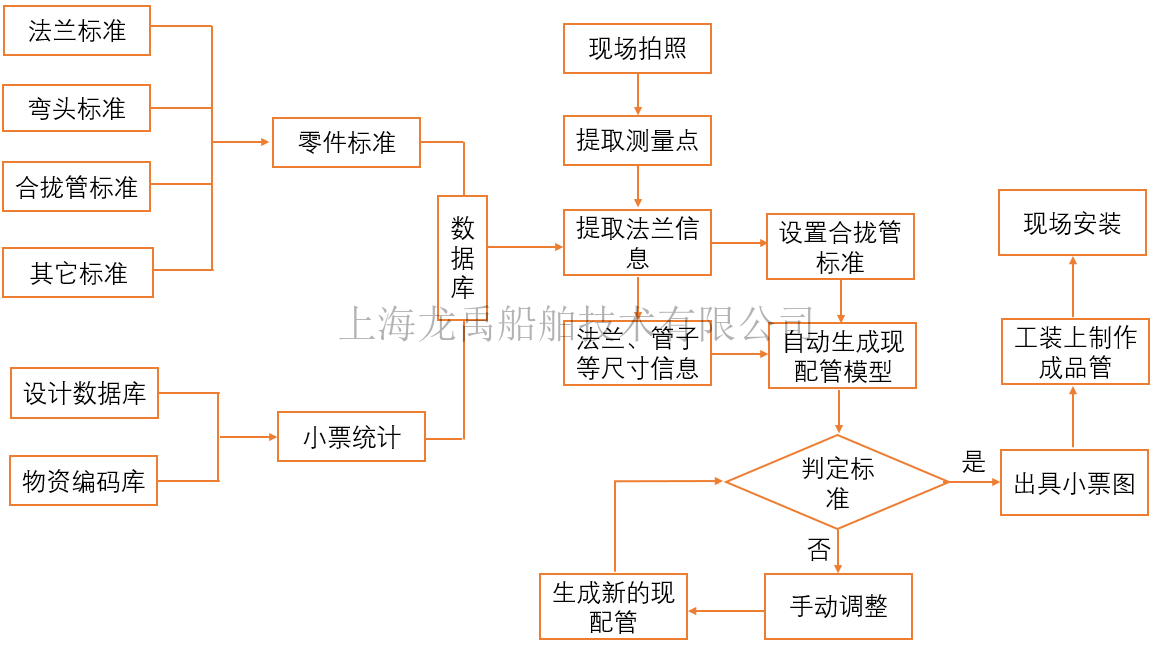
Figure 1 Application Flowchart
II. Advantages of the Measurement System
◆ Small and lightweight equipment, simple operation
◆ Measurement accuracy up to micrometer level
◆ Can measure more than two closing pipes simultaneously
◆ There is no limit to the measurement range of flange size and length (only with sufficient reference scales)
◆ Can measure on-site obstacles to meet the requirements of software design pipelines to avoid obstacles
◆ Can be used independently for rapid detection of finished pipe fittings, achieving quality inspection of finished pipe fittings after welding
III. Software Features
◆ The database standard is open, and users can edit it themselves
◆ Supports various flange, elbow, bent pipe, and pipe standards
◆ Length and angle dimensions can be manually adjusted
◆ Parametric three-dimensional modeling
◆ Can be interfaced with AM design software to generate flanges, pipes, and design drawings that are consistent
◆ Has a professional software development team that can continuously develop and upgrade (marking points, beveling, different diameters, etc.)
IV. Comparison of Prefabricated Pipe System and Traditional Process
Compared with the traditional process, the pre-fabricated pipe system greatly optimizes the processes of the traditional pre-fabricated pipe process, saving a lot of manpower and material resources. Calculated based on 10 ships per year, approximately 5 million can be saved.
Table 1 Comparison of Effects between Traditional Process and Prefabricated Pipe System
Table 2 Comparison of Processes between Traditional Process and Prefabricated Pipe System
Company Address: Room 201, Building 11, No. 299, Bisheng Road, Pudong New District, Shanghai
Company Telephone:021-33830252
Company Fax: 021-33830253
Company Postcode: 201204
Company Email:service@shipac.com.cn