

Application of container ship simulation and box testing methods
The container ship loading system is an important part of ultra-large container ships. Its installation and submission are directly related to the construction quality and cycle of container ships. The traditional physical test box scheme requires two physical test boxes, self-test box and external lifting box, to ensure the accuracy and success rate of the test box. This is time-consuming and resource-intensive, which restricts the construction speed. In order to further optimize the measurement methods of digital simulation test boxes, a scheme using large-scene 3D point cloud technology to simulate test boxes is proposed to achieve data acquisition and data analysis, and a scheme using computer software technology and AI artificial intelligence technology. Practice has proved that this method not only effectively saves the utilization rate of kinetic energy resources, but also brings a huge efficiency improvement to the test box operation.
I. Background Introduction
The container ship loading system is an important part of ultra-large container ships. Its installation and submission are directly related to the construction quality and cycle of container ships. Traditional physical trial box schemes require two physical trial boxes, self-trial box and external crane box, to ensure the accuracy and success rate of the trial box. This process is time-consuming and resource-intensive, restricting the construction speed. In order to further optimize the measurement methods of digital simulation trial boxes, a scheme using large-scale 3D point cloud technology to simulate trial boxes is proposed to realize data acquisition and data analysis, and through computer software technology and AI artificial intelligence technology. Practice has proved that this method not only effectively saves the utilization rate of kinetic energy resources, but also brings a huge efficiency improvement to the trial box operation.
Our company started researching the method of digital simulation of trial boxes based on large-scale 3D point clouds in 2015: Through the implementation of mature point cloud measurement schemes, the development of professional 3D point cloud simulation trial box software, and after many product and technology iterations, a mature simulation trial box software system based on large-scale 3D point clouds has been gradually formed and successfully applied in many influential domestic shipbuilding enterprises.
II. Technical Overview
Using high-precision 3D laser scanning technology, digital point cloud processing and AI-assisted processing technology, after completely collecting the point cloud data of the container ship's cabin, the dedicated processing software simulates the situation of containers falling and stacking in the guide rails. It assists users in quickly judging and analyzing the construction status of the cabin guide rails. This saves a lot of manpower, material resources, and time consumption caused by traditional hoisting trial boxes, thereby improving production efficiency.
III. Trial Box Process
3.1 Field Scanning
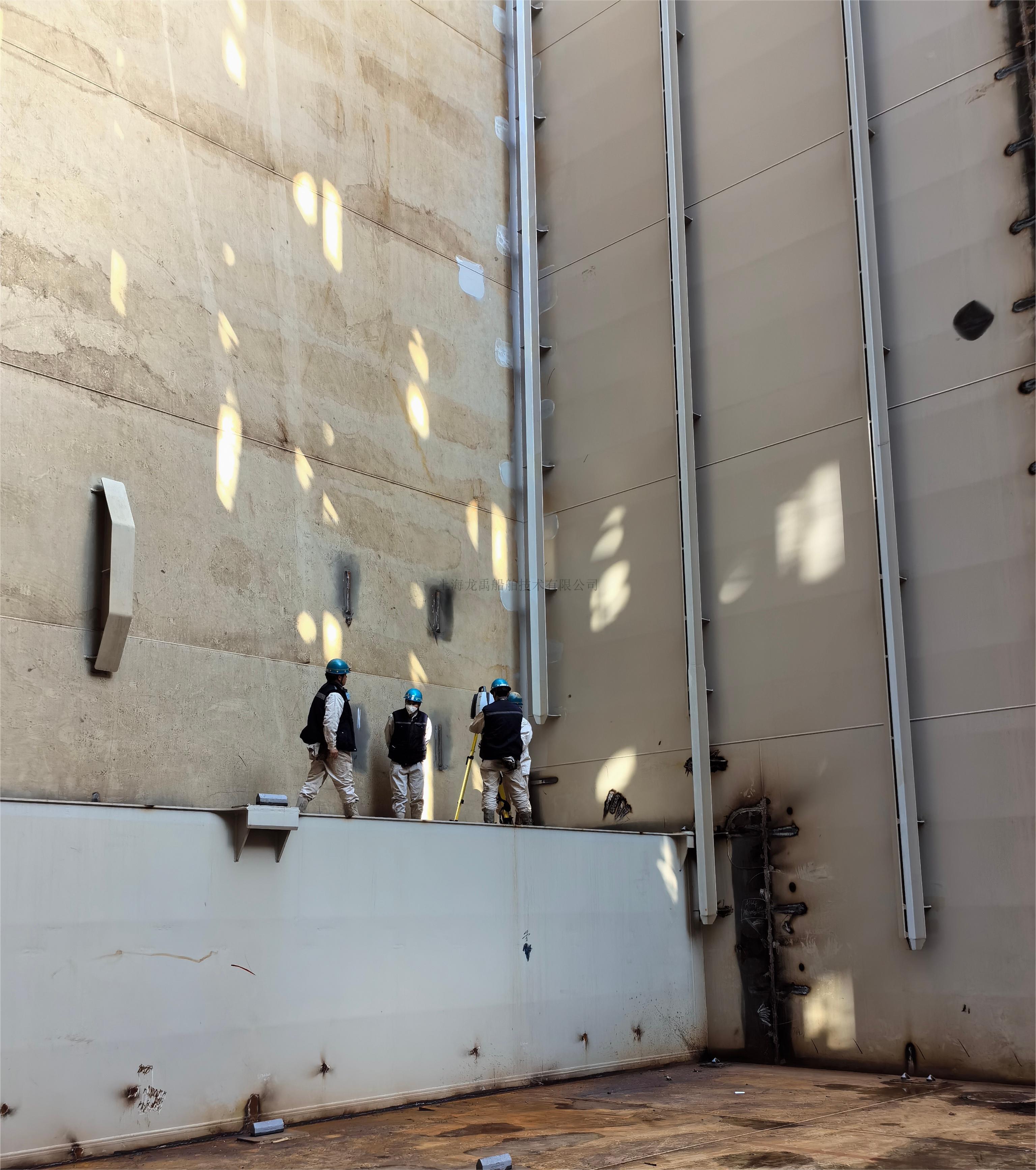
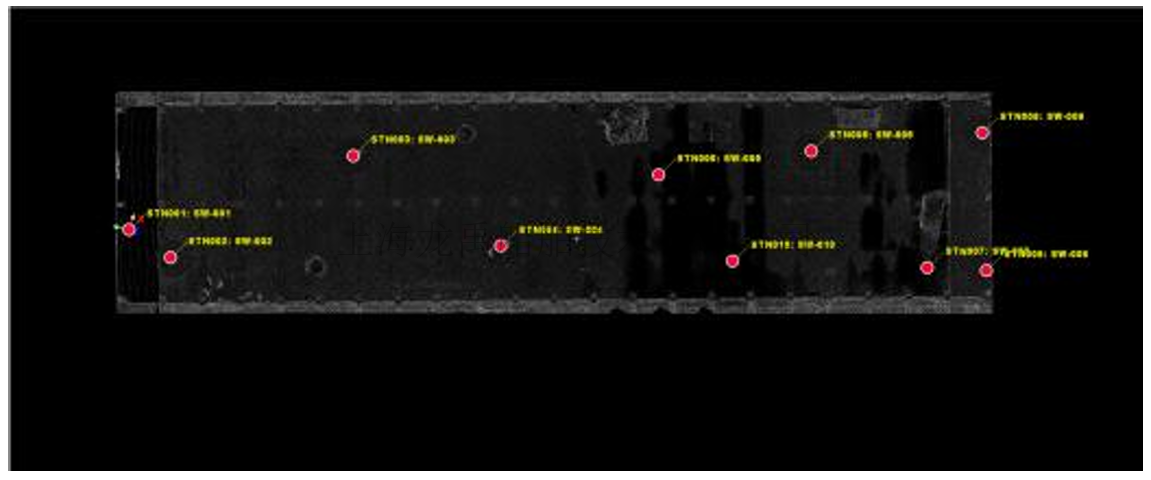
Taking 24000TEU as an example, a single compartment is 14m long, 56m wide, and 32m high, with a diagonal length of 68m. According to the on-site situation, one compartment requires 8-10 stations. Each station takes 3 and a half minutes to collect data. Additional stations are scanned in locally easily obscured locations. The entire compartment's guide rails can be scanned within an hour, including on-site scanning and station relocation.
Requirements: The on-site scanning environment requires no occlusion, no vibration, and no cross-operation to ensure the stable progress of the scanning process.
Scanning route setting: As shown in the figure below, the instrument setting positions are arranged in a W shape. 8-10 stations can be completed under good scanning environment.
3.2 Data Stitching
On the computer, the data scanned from multiple stations is fitted and spliced using point cloud splicing software, mainly through view splicing and target splicing methods. The accuracy of the dock ground scanning data can be ensured by view splicing. For underwater scanning and measurement data, it is recommended to use target splicing to ensure accuracy. The point cloud splicing accuracy is required to be provided in a report based on beam adjustment, and the accuracy is required to be controlled within 1mm.
3.3 Point Cloud Lightweight
Point cloud lightweight is achieved in two steps. The first step is to delete the redundant miscellaneous points and retain only the effective guide rail data and base plate data; the second step is to decimate the point cloud data. The average point spacing is usually set to 5mm to meet the calculation requirements of the simulation trial box software.
3.4 Simulation Trial Box
3.4.1 Import Point Cloud Data
Open the CellGuide simulation trial box software, import the spliced point cloud data, and re-orient the coordinates to the hull coordinate system.
3.4.2 Automatic Box Position Segmentation
Set the box position segmentation parameters, and the software automatically segments the entire cabin point cloud data into single box position data, and completes the numbering of the box positions. The numbering principle of the box positions is consistent with the naming rules of the shipyard.
The completed data, guide rail detection, and base plate flatness detection are processed in zones in the software, which can simplify the analysis process and improve work efficiency.
3.4.3 Extract Guide Rail and Cone Data
In the process of processing individual box position data, the local point cloud filtering function is used to retain only the point cloud data of the guide rails, cones, and guide sliders.
The guide rail point cloud data can show the construction size deviation of the guide rail and the gap deviation between the container and the guide rail; the cone point cloud data can show the cone size deviation, the container and the cone are aligned in the bottom layer box position, and the gap deviation between the top surface of the container and the guide rail; the guide slider point cloud data can show the left and right installation position deviation of the guide slider.
3.4.4 Guide Rail Trial Box Calculation
Set the trial box parameters according to the construction process requirements. The entire trial box process is automatically calculated by the software, highlighting the error color scale distinction, and supporting four corner local views to check the landing gap status.
3.5 Trial Box Report Generation
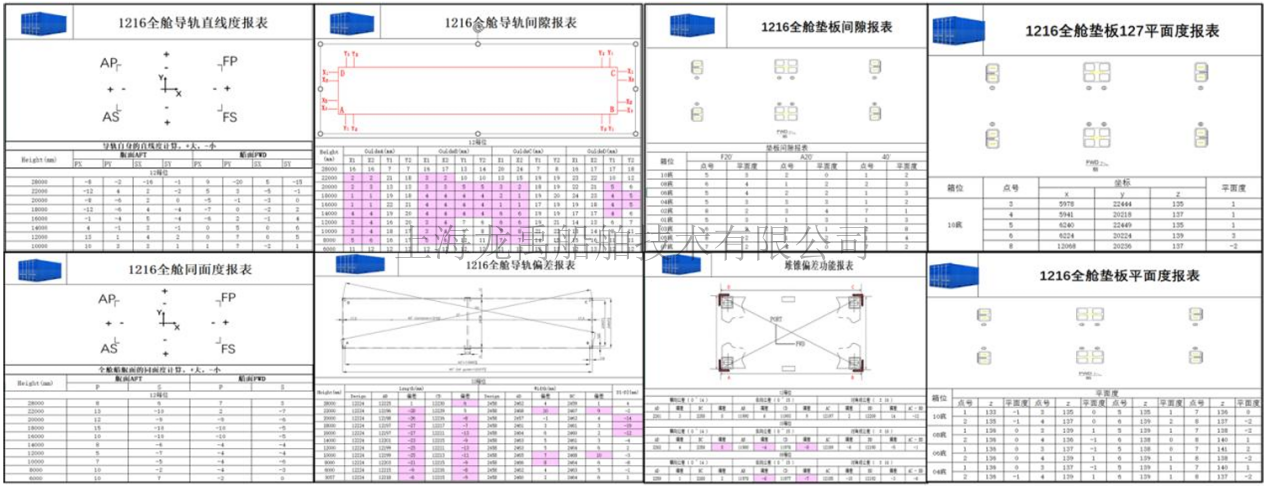
The software can realize the one-click export report function, automatically writing the trial box data into the excel report. The report content includes (full cabin cone report, full cabin guide rail gap report, full cabin guide rail deviation report, full cabin guide rail straightness report, full cabin base plate 127 flatness report, full cabin base plate gap report, full cabin base plate flatness report, full cabin coplanarity report), and can also be customized according to user requirements.
IV. Benefits the System Brings to Users
4.1 Improved Work Efficiency
(1) In terms of data acquisition and analysis efficiency, compared with the traditional total station digital trial box implementation, the digital simulation trial box implemented based on large-scale 3D point cloud technology greatly simplifies the trial box process, reduces personnel and time input, and effectively improves the trial box operation efficiency by more than 5 times.
(2) In terms of quality handover, compared with physical trial boxes, digital simulation trial boxes implemented based on large-scale 3D point cloud technology only require spot checks or checks of defective parts, eliminating the need to use real boxes or frame boxes for landing inspections, reducing manpower, and reducing the on-site time for quality handover by more than 7 times.
(3) In terms of reporting time, compared with the total station point measurement analysis simulation trial box method and the physical trial box, the digital simulation trial box implemented based on large-scale 3D point cloud technology can save 5-6 times the working hours for a single ship, and the total working hours can be saved by 5-6 times.
4.2 Direct Benefit Improvement
(1) Traditional test boxes require two crane lifts per position: one for positioning the guide rails and self-inspection, and another for the shipowner's inspection. Before the shipowner approves the simulated test box, it is used for positioning and self-inspection during construction. The shipowner's inspection uses a crane lift for verification, reducing the number of lifts by approximately 50% compared to traditional test boxes. By collecting data and obtaining the shipowner's approval of the simulated test box, we gradually replace some or all of the physical test boxes on the ship, ultimately achieving greater economic benefits.
(2) Reducing physical test boxes saves crane resources and energy. It enables test box operation under any conditions. It is estimated that a single ship can save 240 lifts. At 1000 yuan per lift, this saves 240,000 yuan per ship; it saves 15 days of crane occupancy; and data collection and analysis efficiency for simulated test boxes on a single ship is increased fourfold, saving 100,000 yuan per ship.
4.3 Indirect Benefit Enhancement
(1) Reducing high-altitude work for test boxes reduces safety hazards from installation collisions, decreases the frequency of inefficient crane use, reduces energy consumption, and achieves green shipbuilding;
(2) Improves the company's measurement technology, facilitating the application research of digital simulation of lashing systems, hatch cover systems, etc.
V. Advantages of the CellGuide Digital Simulation Test Box Software
5.1 High Software Automation
Except for necessary manual confirmations, it basically achieves fully automated data processing.
5.2 Lightweight Processing of Massive Point Cloud Data
Only the guide rail and pad point cloud data need to be retained; other invalid point clouds can be quickly deleted.
5.3 Higher Test Box Processing Efficiency
The software incorporates AI intelligent algorithms to effectively improve calculation accuracy and efficiency.
5.4 After-Sales and R&D Team Support
The technical team is responsible for comprehensive training; the R&D team promptly addresses and processes software function requirements and issues, and provides upgrades.
5.5 Domestic High-Quality Software
Easy to learn and use, with completely independently developed algorithms and engines, unaffected by foreign restrictions.
Company Address: Room 201, Building 11, No. 299, Bisheng Road, Pudong New District, Shanghai
Company Telephone:021-33830252
Company Fax: 021-33830253
Company Postcode: 201204
Company Email:service@shipac.com.cn